Single-Acting vs. Double-Acting Valve Actuators: Comparison and Use Cases

George Packard
Vice President of Marketing
Read Full Bio
Intro
Single-acting and double-acting actuators automate valve movement in distinct ways, and those differences directly influence performance and safety. A single-acting actuator, often referred to as a spring return valve actuator, uses air in one direction and a spring in the other to return the valve to a fail-safe position in the event of a power or air failure. A double-acting ball valve actuator relies on air for both strokes, delivering fast cycling, compact sizing and long service life. These traits guide where each actuator performs best across industrial applications.
What Is a Single-Acting Actuator?
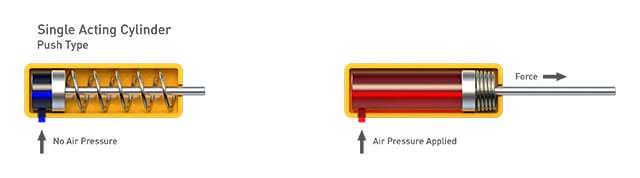
Commonly referred to as spring-return actuators, a single-acting pneumatic actuator uses air to open the valve and a mechanical spring (or springs) to close the valve. The actuator can also be configured inversely so that air closes the valve and the spring is used to open the valve; this is called a normally-open configuration.
The most common reason single-acting actuators are chosen is for their reliable fail-safe design. This means that if power or air pressure is lost, the valve will quickly move to the normal position. This is useful in applications where serious consequences may occur if the valve remains open (or closed) when power and/or air pressure is lost.
Three drawbacks to single-acting actuators are:
- The inclusion of mechanical springs in the design adds additional cost to the valve assembly. Cost difference depends on the size and style of the valve.
- The springs are susceptible to fatigue and will usually be the first component in the actuator to fail. Therefore, single-acting actuators are generally considered to be less durable than double-acting actuators.
- The spring-modules give the actuator a larger form factor that may not be compact enough to fit into some applications.
What Is a Double-Acting Actuator?
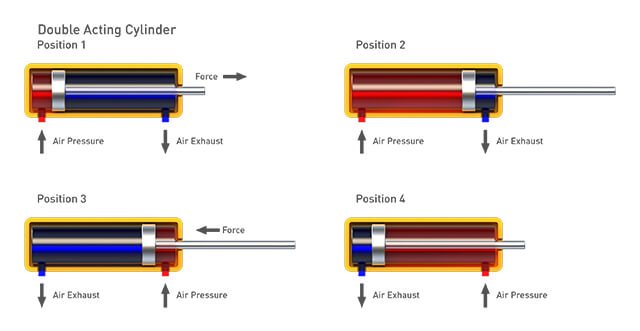
Unlike single-acting actuators, double-acting actuators use air pressure to both open and close the valve.
This is the most popular style of pneumatic valve actuator. Double-acting actuators are selected for their lower cost and superior longevity, since the absence of mechanical springs in most models eliminates the least durable component in the actuator. It is not uncommon for a high-quality double-acting actuator to cycle millions of times before failing.
Key Differentiators of Single-Acting vs. Double-Acting Valve Actuators
The distinctions below outline how each actuator responds in service and why certain applications benefit from one style over the other.
| Single-Acting Valve Actuator | Double-Acting Valve Actuator | |
| Return Type | Air opens (or closes) the valve; spring drives the return stroke | Air pressure drives both the opening and closing strokes |
| Power Source | Air required for one stroke; spring handles the opposite stroke | Air required for both strokes |
| Response Speed | Slightly slower due to spring tension | Faster cycling; no spring resistance |
| Fail-Safe Position | Built-in fail-safe based on spring position | No inherent fail-safe unless paired with external failsafe system |
| Energy Use | Lower air consumption during one stroke | Higher total air consumption due to air-driven return stroke |
| Control Method | Simple control logic tied to spring-return behavior | More flexible control; precise positioning with air on both sides |
| Maintenance Needs | Spring can fatigue over time; eventual replacement expected | Fewer wear components; longer service life |
| Best For | Safety-critical systems requiring a predictable fail-safe position | High-cycle, compact installations where fast response and longevity matter |
When to Use A Single-Acting Actuator
Single acting actuators are common in low to moderate cycle applications where the valve failing in the wrong position could present a serious safety hazard and/or cause damage to nearby equipment. If power or air pressure is lost, single-acting actuators ensure that the valve will fail to the normal position. For this reason, single-acting actuators are the best choice when the simplicity and reliability of a safety system are of the utmost concern.
When to Use a Double-Acting Actuator
Double-acting actuators are ideal for high cycle applications and/or applications where the valve failing to the closed (or open) position when power is lost does not present a critical issue. Double-acting actuators are the most popular choice for their lower cost and superior longevity. Double-acting actuators are also more compact than single-acting actuators and may be the only option in small form factor applications.
Double-Acting with Failsafe
Gemini Valve now offers an industry-first double-acting pneumatic actuator with failsafe. This actuator combines the durability of a double-acting actuator with the failsafe normally only offered by spring-return models. The actuator operates in a double-acting configuration until power or air pressure is lost and the springs engage automatically to return the valve to the normal position.
Move Forward With the Right Actuator Choice
The type of valve actuator you choose depends on your specific application. When it comes to deciding whether single- or double-acting actuators are right for your situation, the team at Gemini Valve can offer expert guidance and advice.
Let’s Talk Valve Actuators
Single-Acting vs. Double-Acting Actuators FAQs
How do I choose the right actuator for my application?
Selecting the right actuator begins with evaluating how critical the fail-safe position is, how frequently the valve will cycle and how much installation space is available.
Choose a single-acting actuator when:
- A predictable fail-safe position is required
- The valve cycles at a low or moderate rate
- Safety behavior during air or power loss is a priority
Choose a double-acting actuator when:
- The system involves high cycle rates
- Space is limited
- Fast, consistent actuation supports performance goals
Which actuator type is more energy-efficient?
A single-acting actuator typically uses less air overall because air pressure is required for only one stroke. A double-acting actuator consumes more air due to air-driven movement in both directions. The efficiency difference becomes more noticeable in systems that cycle frequently.
What are the typical maintenance requirements for each type?
Single-acting actuators rely on internal springs that may fatigue over time, so spring replacement is the most common maintenance task. Double-acting actuators have fewer wear components, which supports longer service life and generally reduces maintenance needs. Routine inspection for air leaks and seal integrity is recommended for both types.
What industries commonly use single-acting and double-acting actuators?
Single-acting actuators are used in environments where a fail-safe position is essential, such as chemical processing, water treatment and safety-related shutdown systems. Double-acting actuators appear in high-cycle industrial settings, including manufacturing, automated process equipment and systems that need compact, responsive actuation.
Which actuator responds faster?
A double-acting actuator typically responds faster because air pressure drives both strokes with no spring resistance. Single-acting actuators may cycle slightly slower due to the return spring, though this depends on air supply, actuator size and operating conditions.
George Packard
Vice President of Marketing
George Packard, Vice President of Marketing at Gemini Valve, has been involved in Technical Sales and Marketing in the valve industry for over 10 years. George’s varied experience includes communicating with clients to troubleshoot critical applications, and working alongside top engineers in the industry to promote the latest innovations in automated ball valve design.
Your Complete Guide To Valve Actuators
A comprehensive introduction to valve actuators, covering power sources, failsafes, questions to ask and more.