Types of Valves for Data Center Cooling Systems

George Packard
Read Full Bio
As data centers scale to meet surging demand from AI and cloud computing, the infrastructure keeping them cool has never been more important, with liquid cooling systems becoming the new industry standard. At the center of those systems are valves: the components that control coolant flow, protect equipment during power events and determine whether a system can respond to changing thermal loads.
This guide breaks down some of the valve types most commonly used in data center cooling, what to consider while selecting them and what it looks like when the right valve partnership comes together.
Why Are Valves Critical to Data Center Cooling?
Data centers fuel today’s digital economy, powering everything from cloud computing and financial transactions to AI workloads, which require serious processing density. All of that computing generates enormous amounts of heat, and managing it is one of the most pressing challenges data center operators face.
Cooling systems in modern data centers are made up of sophisticated, always-on networks of pipes, pumps, chillers, heat exchangers and cooling distribution units. And at the heart of those systems are valves. Valves direct coolant and water flow, control their volume and facilitate shutoff when something goes wrong. A single valve failure at the wrong moment can interrupt cooling to a server rack, trigger a thermal shutdown or cascade into extended system shutdown, resulting in the kinds of outages that can damage hardware and cost thousands of dollars.
What makes valve selection especially consequential in data center applications is the combination of the demands at play: 24/7 uptime requirements, zero tolerance for unplanned shutdowns, increasingly dense thermal loads from AI infrastructure and a shift toward liquid cooling technologies. To meet these demands, the valves powering data center cooling systems must be precise, reliable and capable of responding automatically to changing conditions.
What Types of Valves Are Used in Data Center Cooling Systems?
To function properly, data center cooling systems rely on a range of different valve types, and one of the most important of these is the ball valve.
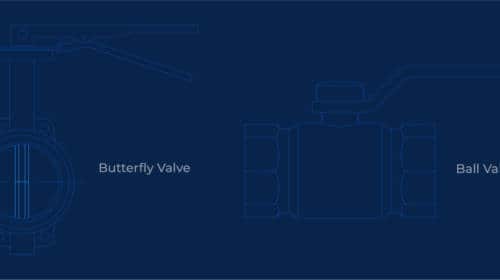
A ball valve uses a rotating spherical ball with a drilled-through bore to control fluid flow. A quarter turn of the valve either aligns the bore with a pipe (fully open) or blocks it completely (fully closed). It’s these mechanics that make ball valves a good choice for applications that require reliable on/off flow control. And when it comes to use in data center cooling systems, their fast actuation, tight shutoff and long service life especially recommend them for the job.
Here are a few of the different kinds of ball valves that are most commonly used:
Electric Actuated Ball Valves (On/Off)
An electric actuated ball valve pairs a standard ball valve with an electric, motor-driven actuator, enabling automated open/close control without requiring a compressed air supply. These are among the most commonly specified valves in modern data center cooling systems, particularly for OEM equipment manufacturers building cooling distribution units, in-row coolers and rear-door heat exchangers. Electric actuation is preferred where pneumatic infrastructure isn’t available or practical, and where slower, controlled cycle times are needed to prevent water hammer in high-velocity or high-pressure liquid cooling lines.
Electric Actuated Ball Valves With Failsafe
Electric actuated failsafe valves add a critical safety function. In the event of a power loss, the actuator automatically returns the valve to a predetermined “safe” position (either fully open or fully closed) using a stored energy source such as a capacitor or battery backup. In data center cooling, this capability is essential for ensuring that a power interruption doesn’t leave coolant circuits in a configuration that could cause equipment damage or thermal runaway. As AI-driven server densities push thermal loads higher, valves that actively protect cooling circuits during power events have become one of the top requirements we’ve heard from the data center market.
Electric Actuated Ball Valves With Positioning (Modulating)
Modulating electric actuators allow the valve to be stopped and held at any point between fully open and fully closed, enabling proportional flow control rather than simple on/off cycling. This means it’s possible to adjust coolant flow rates in real time based on temperature sensor feedback, building management system commands or programmable logic controller inputs. In data centers, modulating valves make it easier to prioritize energy efficiency, delivering the right amount of cooling required at any given moment rather than continuously running systems at full capacity.
Pneumatic Actuated Ball Valves
Pneumatic actuated ball valves use compressed air (typically at 60–125 PSI) to drive the valve open or closed. They’re fast, cycling in as little as half a second, and can achieve high cycle counts, making them a strong choice in high-frequency applications where compressed air infrastructure is already in place. Double-acting pneumatic actuators offer a smaller footprint than their electronic counterparts and perform well across a wide temperature range. Some configurations also offer a double-acting design with failsafe capability, combining the durability of double-acting operation with the automatic safe-position return function normally associated with spring-return models.
3-Way Ball Valves
A 3-way ball valve has three ports and can be configured to divert flow from one path to another, blend two inlet streams or shut off flow entirely. In data center cooling, 3-way valves are used to manage bypass circuits, switch between primary and secondary cooling loops and direct coolant flow in free-cooling configurations — for example, routing chilled water through a bypass loop when ambient conditions allow free cooling to carry the load.
| Valve Type | How It Works | Best For | Data Center Relevance |
| Electric Actuated Ball Valves (On/Off) | Electric motor drives the ball valve open or closed; no compressed air required | OEM equipment without pneumatic infrastructure; applications requiring water hammer prevention via controlled cycle times | Among the most commonly specified valves in CDUs, in-row coolers and rear-door heat exchangers |
| Electric Actuated Ball Valves With Failsafe | On power loss, a capacitor or battery backup automatically returns the valve to a safe preset position | Critical cooling circuits where a valve stuck in the wrong position during a power event could cause equipment damage or thermal runaway | High-priority requirement as AI server densities increase thermal loads and the consequences of power interruptions grow |
| Electric Actuated Ball Valves With Positioning (Modulating) | Actuator holds the valve at any position between open and closed, enabling proportional flow control | Systems requiring real-time flow adjustment based on BMS commands, PLC inputs or temperature sensor feedback | Key to energy efficiency; delivers precisely the cooling required rather than running at full capacity; supports complex OEM cooling system designs |
| Pneumatic Actuated Ball Valves | Compressed air (60–125 PSI) drives the valve open or closed; solenoid valve controls air direction | High-frequency, high-cycle applications where compressed air is already available; environments requiring fast actuation (<1 second) | Compact footprint vs. electric; double-acting with failsafe option available for safe-position return on air or power loss |
| 3-Way Ball Valves | Three-port design diverts, blends or shuts off flow across two paths simultaneously | Bypass circuits, switching between primary and secondary cooling loops, free-cooling configurations | Routes chilled water through bypass loops when ambient conditions allow free cooling, reducing chiller load |
Valve Selection Considerations for Data Center Cooling
Selecting the right valve for data center cooling is crucial and goes beyond matching a valve to a pipe size. Several factors distinguish valves that perform reliably from those that will become a liability. To set your operation up for success, consider the following:
- Actuation type: The choice between electric and pneumatic actuation is often determined by whether compressed air infrastructure exists on-site. Electric actuators are increasingly preferred for data center OEM equipment because they eliminate the need for a dedicated air supply and integrate more cleanly with digital building management systems. Within the electric category, the choice between basic on/off, failsafe and modulating configurations should be based on where the valve sits within the system and what’s at stake if it fails in the wrong position.
- Failsafe requirements: Any valve in a critical cooling circuit (particularly on the supply side of high-density server equipment) should be evaluated for failsafe capability. Understanding the required fail position (open vs. closed) for each application is essential, and that determination should be made to reflect the system’s overall safety and redundancy design.
- Modulating vs. on/off control: For applications that simply need to isolate or open a flow path, a standard on/off valve should be sufficient. However, in circuits where flow rates need to track thermal demand in real-time, a modulating valve paired with a smart controller can reduce energy consumption and improve temperature stability.
- Material compatibility: Data center cooling fluids may include deionized water, propylene glycol blends or specialized dielectric coolants. Valve body, ball, seat and seal materials must be compatible with the specific coolant chemistry to avoid degradation over time. Stainless steel bodies with PTFE seats and Viton seals are a common choice for their broad chemical compatibility and corrosion resistance.
- Size and space constraints: Data center equipment, particularly CDUs and in-row coolers, is often engineered to tight physical dimensions. Compact valve designs that deliver full performance in a smaller size are important for OEM manufacturers who need to fit valve assemblies into finished equipment without compromising thermal or flow performance.
- Lead times and domestic supply: Data center construction ramping up, valve supply chain reliability matters. Working with a domestic manufacturer that designs, produces and tests valves in-house offers an advantage in lead time predictability and the ability to accommodate custom specifications without extended delays.
Case Study: Energy Link
For data center OEM manufacturers, the domestic supply chain advantage isn’t just theoretical. When Energy Link — a company that designs and builds control systems for emission-related applications — needed a reliable valve and actuator assembly for their process equipment, off-the-shelf options couldn’t meet the mark. Their requirements were specific: a two-way stainless steel ball valve paired with a 24 VDC fail-safe electric actuator, built to precise size and performance specifications.
We connected Energy Link’s team directly with our design engineers, who recommended a modified assembly featuring a capacitor-based auto-return mechanism, and were able to deliver a prototype within five business days. As the project evolved, we updated specs, sourced UV-rated cable and adjusted production to match Energy Link’s delivery schedule, including accommodating expedited shipments without missing deadlines. The initial order of 400 fully assembled and tested units was completed on time, allowing Energy Link to integrate components ahead of schedule.
The partnership has continued well beyond that first order, with Energy Link incorporating the Gemini assembly into their standard product design and orders placed through 2027 and beyond.
Want the full story? Check out our case study here.
This example illustrates exactly what data center OEM manufacturers and system integrators are looking for in a valve partner: custom engineering capability, fail-safe reliability, fast prototyping and a domestic supply chain that can keep pace with production demand.
Ready to Spec the Right Valve?
Data center cooling systems are only as reliable as the components they’re made from. Whether you’re specifying valves for a new chilled water system, sourcing assemblies for OEM cooling equipment or evaluating how your current setup would hold up in a power event, valve selection deserves just as much care and thought as any other element of the system.
That consideration extends beyond the spec sheet. It should also account for elements such as actuation type, fail-safe requirements, flow control needs, material compatibility and a supply chain you can count on when timelines are tight.
That’s where a valve specialist can help. Contact Gemini Valve today to speak with a member of our team and find the solution your system needs.
George Packard